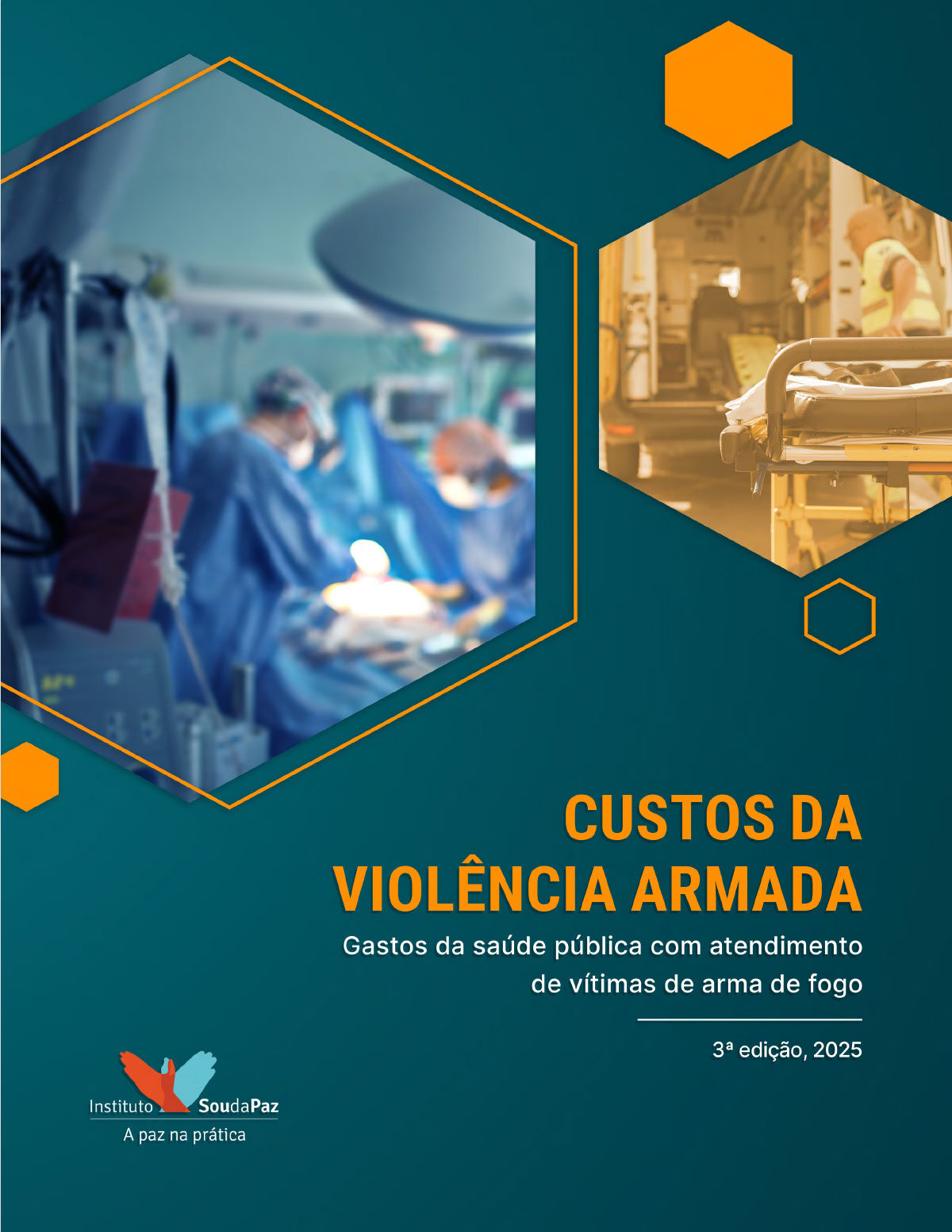
On 18 December 2025, Instituto Sou da Paz launched the third edition of Custos da Violência Armada, a major new report examining the health-system impacts and public costs of firearm violence in Brazil. Drawing on national hospital data, the report shows that firearm-related injuries continue to consume tens of millions of reais annually in public health spending, disproportionately affecting men, young people, and Black Brazilians: In 2024, 15,800 hospital admissions for firearm-related injuries cost Brazil’s public health system R$ 42.3 million (≈ US$ 7.8 million). Over the past decade (2015–2024), federal spending on these hospitalisations averaged R$ 50.6 million per year—about US$ 9.4 million annually—funds that could otherwise support prevention, primary care, and health services in communities most affected by violence.
It also highlights the extreme lethality of gun violence: for every person hospitalised, two others die before reaching medical care. Sou da Paz is one of Brazil’s leading public-interest organisations, widely recognised for its rigorous research and advocacy to reduce violence and strengthen evidence-based public policy.
Beyond documenting costs, the report advances key implications for the health sector. It affirms the need to treat firearm violence as a public-health issue; to strengthen surveillance, data quality, and reporting beyond hospital admissions; to protect health workers and ensure continuity of services in violence-affected territories; and to prioritise prevention through intersectoral action, including stronger regulation of firearm access and circulation. The report underscores that health expenditures on gunshot injuries represent preventable harm and a diversion of scarce public resources.
At the same time, the report makes clear that these costs are not inevitable. By documenting the scale, distribution, and preventability of firearm-related harm, Custos da Violência Armada reinforces the case for stronger upstream action, including effective regulation of firearms, sustained investment in prevention, and clearer health-sector leadership on violence reduction. In doing so, the report positions health evidence not only as a tool for measuring harm, but as a foundation for shaping national policy and informing international health governance.
The report also includes a dedicated contribution from the Global Coalition for WHO Action on Gun Violence, which is grateful to Instituto Sou da Paz for the invitation to include a brief write-up of the Coalition’s research. This contribution situates Brazil’s health-system evidence within a global public-health context and summarises multi-institutional research showing that, despite the scale, lethality, and preventability of gun violence, the World Health Organization has substantially reduced its attention to firearms over the past two decades. The analysis reviews more than 3,200 World Health Assembly resolutions adopted between 1948 and 2024, finding that none explicitly address firearms, and examines WHO violence-prevention publications over the past 20 years, documenting a marked decline in sustained attention to gun violence.
Together with Sou da Paz’s findings, the Coalition’s research underscores the urgent need for renewed WHO leadership and expresses the hope that this report will help catalyse commitments from the Brazilian government and other WHO Member States to table a World Health Assembly resolution recognising firearm violence as a global public-health priority.
Ends
English translation
Here is the English translation of the Global Coalitions contribution to Sou da Paz’s report:
From Sou da Paz’s Evidence to WHO Action on Firearm Violence.
Sou da Paz’s new report reinforces the urgency of addressing firearm violence as a central public-health challenge and highlights the need for stronger global leadership on gun violence. Recent research shows that the World Health Organization—the world’s leading global health institution—has substantially reduced its focus on firearm violence in recent years, despite its scale, lethality and preventability. A multi-institutional analysis by a consortium of academic centres and advocacy organisations identifies three significant and interlinked gaps in WHO’s work. First, a review of more than 3,200 World Health Assembly resolutions adopted since 1948 finds that none explicitly address firearms, even though violence has repeatedly been recognised as a public-health priority. Second, a review of WHO violence-prevention publications documents a marked decline over the past two decades in sustained attention to gun violence, including in areas where firearms are among the leading causes of death and injury. Third, analysis of PAHO strategies and flagship reports shows that firearm violence is largely absent from regional guidance, including The Health of Adolescents and Youth in the Americas, the PAHO Strategic Plan 2020–2025, and Masculinities and Men’s Health in the Caribbean.
These gaps are increasingly consequential. Gun violence remains a leading cause of premature mortality, particularly among adolescent boys and young men, while the commercial promotion of firearms—especially through digital platforms, gaming, film and social media—continues largely unchecked. The WHO has repeatedly demonstrated its ability to provide leadership on complex and politically sensitive public-health challenges, including tobacco control, road safety, HIV, alcohol harm and violence against women and children. Firearm violence warrants comparable reprioritisation, including WHO guidance on evidence-informed approaches to prevention and response, regulation of access and marketing, health-system interventions, and community-based strategies.
Brazil can demonstrate its global leadership on gun violence by supporting a World Health Assembly resolution calling for renewed WHO action on firearm violence as a global public-health priority. Momentum for such action is already building through the Global Coalition for WHO Action on Firearms, now comprising more than 60 organisations across over 20 countries (https://whoaction.org).