Webinar on 10 November launches new WHO Action report on firearms, violence against women, and femicide
When and where
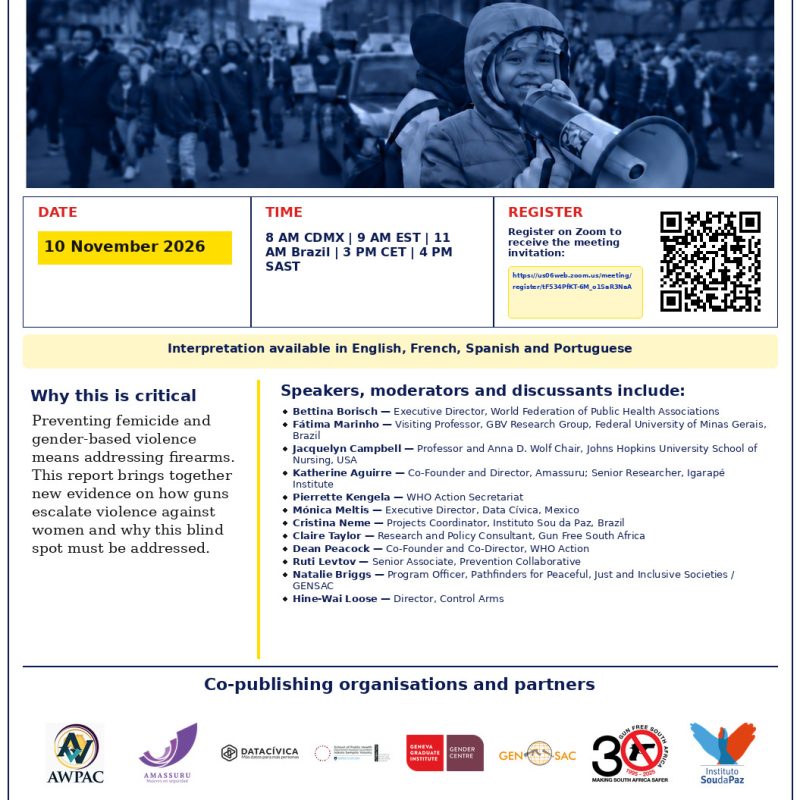
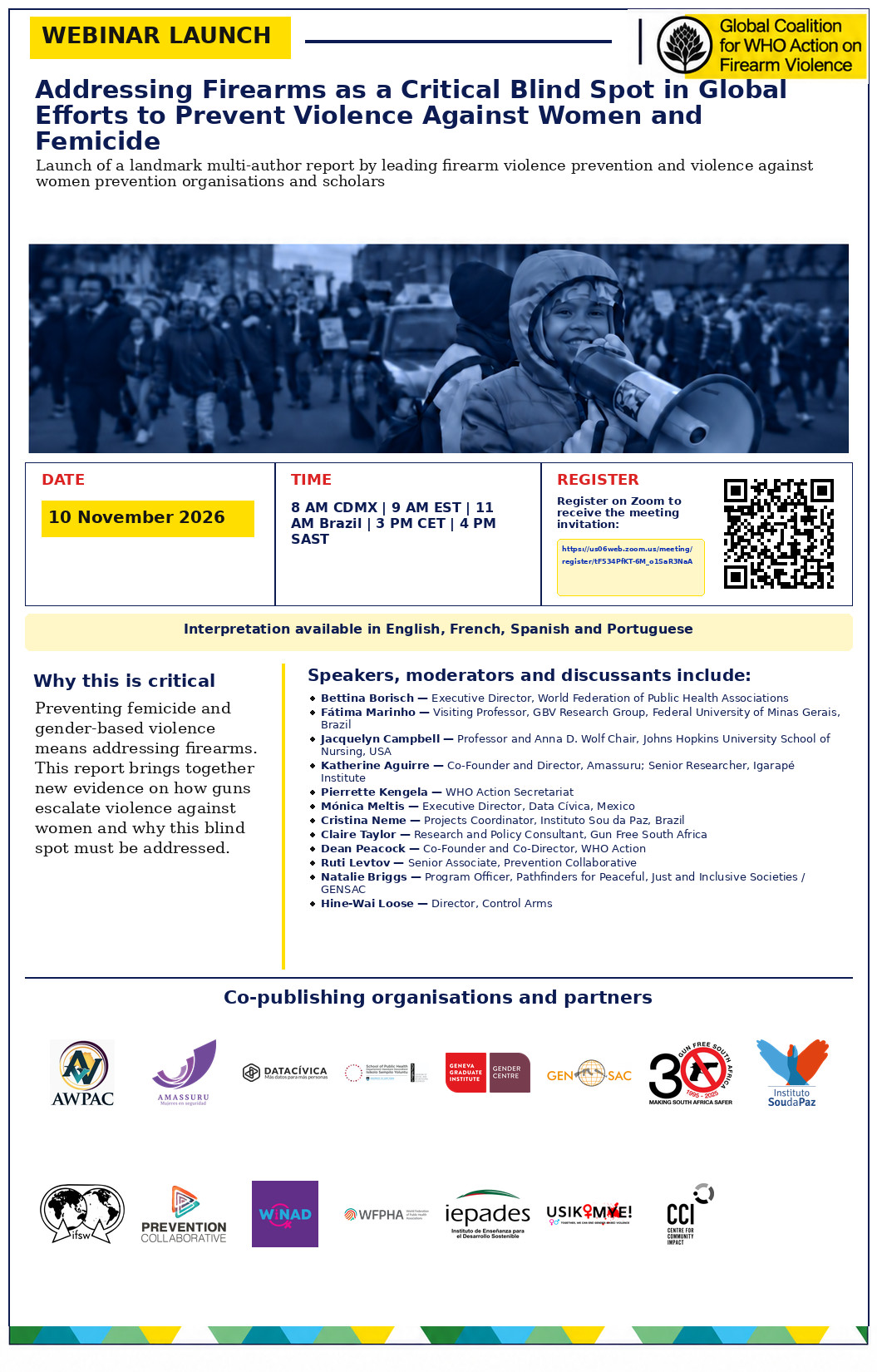
The 90-minute webinar takes place on 10 November at 3 PM CET. Simultaneous interpretation will also be available in English, French, Spanish and Portuguese. Register here.
What’s being launched
The Global Coalition for WHO Action on Firearm Violence and its partners are launching a new report: Addressing Firearms as a Critical Blind Spot in Global Efforts to Prevent Violence Against Women and Femicide. Leading organisations and researchers in both firearm violence prevention and violence against women co-authored it.
The world’s leading femicide researchers
“The world is experiencing an increase in femicide in most countries that are counting and reporting data. The majority of these femicides are committed by male intimate partners,” said Dr Jacquelyn Campbell of the Johns Hopkins School of Nursing. Her research established a perpetrator’s access to a firearm as a key predictor of intimate partner homicide. Campbell opens the webinar.
In addition, the webinar features:
- Welcome remarks from Bettina Borisch, Executive Director of the World Federation of Public Health Associations (WFPHA)
- Opening remarks from Fátima Marinho (Federal University of Minas Gerais), who has led national femicide surveillance work in Brazil
- Panellists Mónica Meltis (Data Cívica), Cristina Neme (Instituto Sou da Paz), Claire Taylor (Gun Free South Africa), Dean Peacock (WHO Action), Ruti Levtov (Prevention Collaborative) and Natalie Briggs, who coordinates the Gender Equality Network for Small Arms Control (GENSAC)
- Moderation by Katherine Aguirre (Amassuru and the Igarapé Institute) and Pierrette Kengela (WHO Action)
- Hine-Wai Loose, Director of Control Arms, as discussant
A rare multi-country comparison
The report examines evidence from Brazil, Mexico, South Africa and the Western Balkans. Few analyses have compared firearms and violence against women across regions in this way. Across all four settings, the findings repeat. First, firearms raise the likelihood that abuse ends in death. Second, legally owned guns appear alongside illicit ones. Third, the systems meant to remove guns from abusive men routinely fail to act.
“Access to firearms exacerbates violence rooted in structural gender inequalities and increases the risk of femicide,” said Cristina Neme of Instituto Sou da Paz, who presents the Brazilian evidence.
Claire Taylor of Gun Free South Africa describes the blind spot at national level: “Guns are currently the leading weapon used to kill women in South Africa, yet the country’s 2020–2030 National Strategic Plan on Gender-Based Violence and Femicide does not mention firearms once. When global guidance is silent, national strategies can be too.”
What it means for health policy
The implications centre on the health sector, because health systems already see women at risk long before femicide occurs. WHO has the mandate and the technical capacity to respond. For example, it can strengthen femicide surveillance. It can also build firearm access into risk assessment and clinical guidance. Finally, it can support firearm removal linked to protection orders.
That case reaches WHO through its own constituency. The webinar opens with a welcome from WFPHA, which brings together national public health associations from across the world and works in official relations with WHO. Because of that reach, its involvement signals that the global public health community regards firearm violence against women as its business.
In Mexico, firearm violence has long been treated as a matter of crime and public security alone. “This paper offers an important opportunity to broaden that perspective by placing human rights, gender, and public health at the centre of the conversation,” said Natalia Ruiz, a co-author of the report at Data Cívica.
In short, the panellists will argue that firearm regulation belongs at the core of violence-prevention policy.
Making femicide visible in arms control
However, the blind spot runs the other way as well: arms control discussions rarely give femicide sustained attention. The panel therefore draws on organisations able to change that:
- The Prevention Collaborative — a global hub for evidence on preventing violence against women
- GENSAC — the network bringing gender equality into small-arms control
- Control Arms — the coalition behind the Arms Trade Treaty, the first treaty to require arms exporters to assess the risk of gender-based violence
- WILPF — the world’s oldest women’s peacebuilding organisation
“For too long, we have treated domestic abuse and community violence as two separate issues. This paper bridges that gap,” said Ayo Ayoola-Amale of WILPF Ghana. “I hope that this research moves us past talking in silos and forces real, coordinated action, putting the safety, dignity, and lived realities of women and girls at the very centre of how we build peace.”
“I hope this paper makes the omission of firearms impossible to defend,” said Pierrette Kengela of the WHO Action Secretariat. Kengela is a survivor of firearm violence and a former frontline nurse, and co-moderates the webinar. “Global strategies and national plans to prevent violence against women must address firearms as an essential part of that work.”
Join us
The webinar takes place on 10 November at 3 PM CET, with interpretation in English, French, Spanish and Portuguese. Register on Zoom.